

Why “Good Enough IT” Is Costing Your Business More Than You Think
- Click IT Solutions
- Feb 26
- 2 min read
Updated: Mar 9
Most growing businesses don’t fail because of bad strategy.
They fail because of small operational cracks that compound over time.
And one of the most expensive cracks? “Good enough” IT.
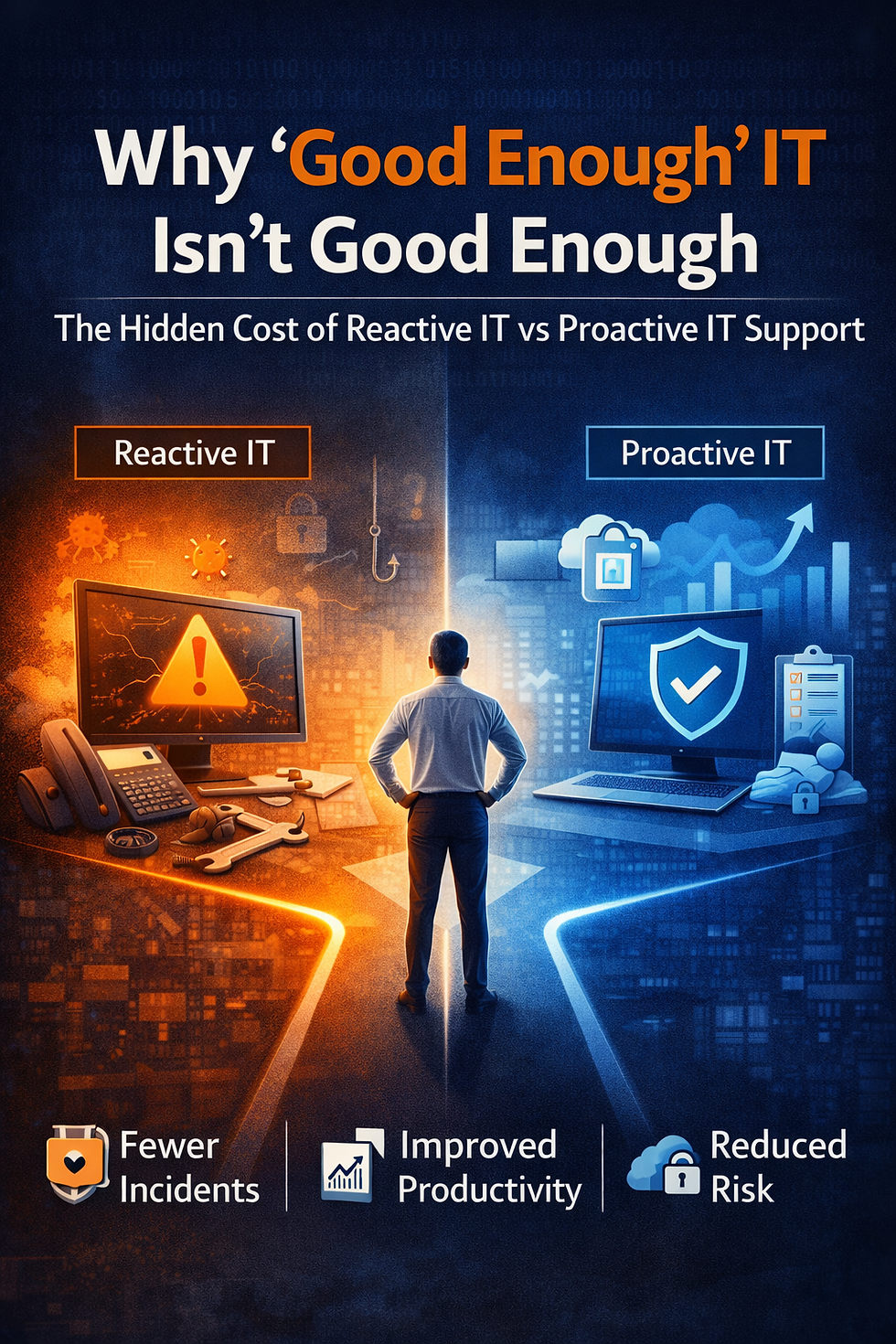
What Does “Good Enough IT” Look Like?
It usually sounds like this:
“The system works… mostly.”
“We haven’t had a major issue.”
“We call someone when something breaks.”
“Security? We’ve got antivirus.”
On the surface, everything feels fine.
Underneath? Risk, inefficiency, and silent exposure.
The Hidden Cost of Reactive IT
Many businesses operate in reactive mode:
Something breaks → log a ticket
Email issue → reset password
Computer slow → replace it
But here’s what’s missing:
Proactive patch management
Security posture reviews
Backup verification testing
Access control audits
Compliance alignment
Process optimisation
Reactive IT fixes symptoms. Strategic IT prevents disease.
Where “Good Enough” Becomes Dangerous:
1. Security Gaps You Don’t See
Examples we see regularly:
Staff using personal cloud storage
External email forwarding enabled
No MFA enforcement
No monitoring of outbound phishing
Excessive admin access
It only takes one compromised account to create a privacy incident.
For legal firms, recruitment agencies, childcare providers, property groups — that’s not just an IT issue. It’s reputational damage.
2. No One Owns the Bigger Picture
If your IT support only responds to tickets:
Who reviews your licensing strategy?
Who plans lifecycle replacement?
Who evaluates emerging threats?
Who ensures backups would actually restore?
Who aligns IT with your growth plans?
Without ownership, IT becomes a cost centre — not an enabler.
3. Productivity Leakage
Slow systems. Poor onboarding. Manual processes. Staff shipping laptops unnecessarily. Cloud tools not optimised.
Individually small. Collectively expensive.
The cost of inefficiency often exceeds the cost of proper support.
What Strategic IT Support Looks Like
A proactive IT partner should be:
Security-first, not convenience-first
Compliance-aware
Focused on prevention, not just response
Involved in quarterly reviews
Tracking trends, not just tickets
Reducing risk over time
You should see:
Fewer incidents
Clear reporting
Structured roadmaps
Controlled access
Tested backups
Documented processes
Not just “closed tickets.”
The Question Every Business Owner Should Ask
If your IT provider disappeared tomorrow:
Would anyone understand your environment?
Are admin credentials controlled?
Are backups documented and tested?
Are security configurations intentional — or accidental?
If the answer is uncertain, that’s your signal.
Final Thought
Technology is now core infrastructure.
It touches:
Client data
Financial systems
Compliance obligations
Staff productivity
Reputation
“Good enough” IT is no longer good enough.
If your business is growing, your IT strategy should be too.


Comments